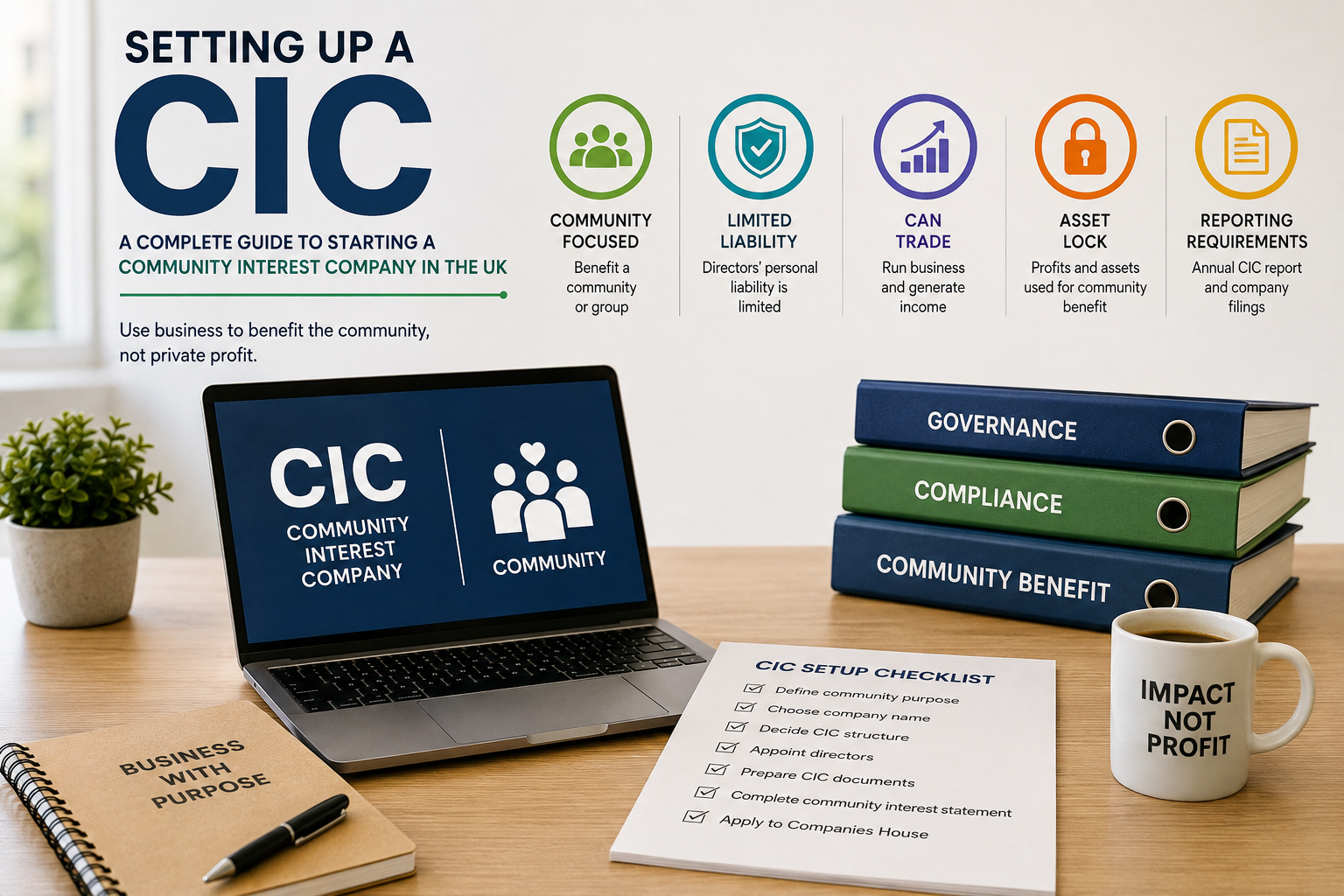
Setting Up a CIC: Complete UK Guide to Starting a Community Interest Company
Starting a business that aims to make a positive difference in society can be both rewarding and financially sustainable. Setting up a CIC (Community Interest Company) is one option for people who want to operate a business while putting community benefit at the centre of their work.
A Community Interest Company can trade, employ staff, enter contracts and generate income while using its activities and resources to benefit a community or a specific group of people. However, CICs also have specific legal requirements that distinguish them from ordinary limited companies.
This guide explains setting up a CIC in the UK, including what a CIC is, how the registration process works, the different types of CIC, ongoing responsibilities, costs and common mistakes to avoid.
What Is a CIC?
A Community Interest Company (CIC) is a special type of limited company designed for organisations that want to use their business activities to benefit the community.
A CIC can operate commercially and make a profit, but its activities must satisfy the community interest requirement. It also has an asset lock, which helps ensure that the company’s assets and profits are primarily used to support its social purpose.
CICs can be used for a wide range of activities, including:
- Community development
- Education and training
- Environmental projects
- Social care services
- Youth programmes
- Employment initiatives
- Arts and cultural projects
- Affordable community services
The key idea is simple: a CIC combines business activity with a clear social or community purpose.
Why Set Up a CIC?
There are several reasons why an entrepreneur, community group or social enterprise might choose a CIC structure.
A Clear Community Purpose
A CIC provides a formal legal structure for an organisation with a social mission. Your community purpose becomes an important part of the organisation’s identity and governance.
Limited Liability
A CIC is a limited company, meaning the company is generally legally separate from its members. This can provide limited liability protection, although directors still have legal responsibilities and can be personally liable in certain circumstances.
Ability to Trade
Unlike some informal community groups, a CIC can operate as a trading organisation. It can sell products or services and use the income to support its community objectives.
Potential Funding Opportunities
Some grant providers and funding organisations support social enterprises and community-focused organisations. A CIC may therefore be suitable for certain funding opportunities.
However, simply becoming a CIC does not guarantee that an organisation will receive grants or funding.
How to Set Up a CIC in the UK
The process of setting up a CIC involves several important steps. Planning your structure and community purpose before applying can make the process much easier.
1. Define Your Community Purpose
The first step is to decide exactly what your CIC will do and who will benefit.
Think about the problem your organisation wants to address and the practical activities you will carry out.
For example, your CIC might provide training for unemployed people, organise community education programmes, support local environmental projects or provide affordable services to a particular group.
Your purpose should be specific and realistic rather than simply stating that you want to “help the community.”
2. Choose a Company Name
You will need to choose an appropriate company name.
The name must follow UK company naming rules and should not be confusingly similar to an existing organisation.
You can check company names through the official Companies House service before submitting your application.
3. Decide Which Type of CIC You Need
There are two main CIC structures:
- CIC limited by guarantee
- CIC limited by shares
A CIC limited by guarantee normally does not have shareholders. Instead, it has members who agree to contribute a specified amount if the company is wound up.
A CIC limited by shares has shareholders and shares. This structure may be suitable where the organisation needs a share-based structure, although CIC-specific restrictions still apply.
The right option depends on your organisation’s objectives, funding plans and governance arrangements.
4. Appoint Directors
A CIC needs directors who are responsible for managing the company.
Directors should understand their legal duties and be able to make decisions that support the organisation’s community purpose.
Before registration, make sure the required director information is accurate and up to date.
5. Prepare the Company’s Governing Documents
You will need appropriate constitutional documents, including articles of association.
The articles explain how the company is governed and how important decisions are made.
CICs have specific requirements relating to their community purpose and asset lock, so using appropriate CIC documentation is important.
6. Complete the Community Interest Statement
The community interest statement is a particularly important part of the CIC application.
It should explain:
- What your organisation will do
- Who will benefit from its activities
- How those activities will benefit the community
- Why the organisation should operate as a CIC
Try to provide practical details instead of broad statements.
For example, saying “we will support local people” is less informative than explaining which people you will support, what services you will provide and what community benefit those services are expected to create.
7. Submit the Application
Once the required information and documents are ready, you can submit the CIC application through the appropriate Companies House process.
The application is subject to the CIC requirements and the community interest assessment.
For the latest official requirements, always check the GOV.UK guidance on Community Interest Companies.
How Much Does It Cost to Set Up a CIC?
The cost of setting up a CIC can vary depending on how you register and whether you use professional assistance.
Potential costs include:
- Companies House incorporation fees
- Legal advice
- Accounting services
- Professional document preparation
- Business insurance
- Bookkeeping and accounting software
- Ongoing company compliance costs
Government fees can change over time, so check the current Companies House fee information before submitting your application.
If your organisation is complex or involves multiple shareholders, investors or unusual arrangements, professional legal or accounting advice may be worthwhile.
How Long Does Setting Up a CIC Take?
The time required to establish a CIC depends on the application method, the accuracy of the information provided and whether additional information is required.
A well-prepared application is less likely to experience avoidable delays.
Before applying, check that:
- Your proposed company name is suitable
- Director information is correct
- Your community purpose is clearly explained
- Your governing documents are appropriate
- Your community interest statement is complete
- All required information has been provided
What Is the CIC Asset Lock?
The asset lock is one of the most important features of a Community Interest Company.
It is designed to protect the organisation’s assets and ensure they are used primarily for the benefit of the community.
A CIC cannot simply treat its assets as personal property or distribute them freely to members or shareholders.
There are specific rules covering asset transfers, dividends and other distributions. These restrictions help ensure that the organisation’s social purpose remains central to its activities.
Can a CIC Make a Profit?
Yes. A CIC can make a profit.
The important distinction is that the organisation must operate for community benefit rather than being established primarily for private profit.
Profits can be reinvested into the organisation and used to expand services, employ staff, purchase equipment or support community projects.
A CIC can therefore be a genuine trading business while still pursuing a social mission.
Can a CIC Pay Its Directors?
A CIC can potentially pay its directors, provided the arrangements comply with the company’s governing documents and relevant legal requirements.
Payments should be properly authorised and recorded.
Directors also have legal duties and should make decisions in the best interests of the company and its community purpose.
If you are unsure about director remuneration, obtaining professional advice is sensible.
CIC Limited by Guarantee vs CIC Limited by Shares
Choosing the right structure is an important part of setting up a CIC.
| Feature | CIC Limited by Guarantee | CIC Limited by Shares |
|---|---|---|
| Shareholders | Usually no | Yes |
| Members | Yes | Yes |
| Shares | No | Yes |
| Profit distribution | Restricted | Restricted by CIC rules |
| Common use | Community and social organisations | Social enterprises with a share structure |
| Asset lock | Yes | Yes |
Neither structure is automatically better. The appropriate option depends on how you plan to operate and finance your organisation.
CIC vs Charity
A CIC and a charity can both have a positive social impact, but they are different legal structures.
A charity must have exclusively charitable purposes and is subject to charity-specific regulation.
A CIC is a limited company designed specifically for community benefit and is regulated under the CIC framework.
A CIC can be particularly useful where the organisation wants to operate a trading business while maintaining a clear community purpose.
If you are unsure whether a CIC or charity is more suitable, compare the legal, tax, governance and funding implications before making a decision.
Ongoing Responsibilities After Setting Up a CIC
Registering your CIC is only the beginning.
Once your company has been established, you will need to meet ongoing legal and administrative responsibilities.
These can include:
- Keeping proper accounting records
- Preparing annual accounts
- Filing confirmation statements
- Maintaining company records
- Meeting directors’ legal duties
- Preparing the required CIC report
- Following asset-lock requirements
- Keeping financial information accurate
- Reporting relevant changes to Companies House
A CIC should also continue demonstrating that its activities support the community purpose described in its governing documents.
What Is a CIC Report?
CICs have additional reporting responsibilities.
The annual CIC report provides information about how the organisation has pursued its community interest and other matters required by the CIC reporting framework.
This helps provide transparency about the organisation’s activities and community impact.
Keeping good records throughout the year can make preparing the report considerably easier.
Common Mistakes When Setting Up a CIC
Choosing an Unclear Purpose
One of the biggest mistakes is creating a vague community purpose.
Your application should clearly explain what you intend to do and who will benefit.
Choosing the Wrong CIC Structure
A limited-by-guarantee CIC and a limited-by-shares CIC have different structures. Consider your long-term plans before deciding.
Assuming a CIC Is the Same as a Charity
A CIC is not automatically a charity and does not automatically receive charity tax benefits.
Ignoring Ongoing Compliance
Some people focus entirely on registration and forget about annual accounts, confirmation statements and CIC reporting.
Expecting Guaranteed Funding
A CIC can apply for suitable grants, but being registered as a CIC does not guarantee funding.
Treating Community Benefit as an Afterthought
The community purpose should be at the heart of your business model. It should influence the activities, governance and use of resources.
Frequently Asked Questions About Setting Up a CIC
Can one person set up a CIC?
A CIC can be established by a small founding team, and the exact requirements depend on the structure and circumstances of the company. Check the current Companies House requirements before applying.
Can a CIC make money?
Yes. A CIC can trade and generate income. The organisation must continue to operate for community benefit and comply with the rules that apply to CICs.
Can a CIC receive grants?
Yes. CICs can apply for grants where they meet the eligibility requirements of the relevant funder.
Does a CIC have to be non-profit?
A CIC is not necessarily a non-profit organisation in the strict sense. It can generate profits, but its community purpose and asset-lock requirements restrict how profits and assets can be used.
Can a CIC employ staff?
Yes. A CIC can employ staff and operate much like other companies while complying with its additional CIC responsibilities.
Is a CIC better than a normal limited company?
That depends on your objectives. If your main purpose is community benefit, a CIC may provide a more suitable structure. If your primary goal is private commercial profit, an ordinary limited company may be more appropriate.
Final Thoughts
Setting up a CIC can be an effective way to build a sustainable organisation around a genuine community purpose.
The structure allows organisations to trade, generate income and employ people while maintaining an asset lock and a clear focus on community benefit.
However, choosing the right structure requires careful planning. You should understand the difference between a CIC limited by guarantee and a CIC limited by shares, prepare a clear community interest statement and make sure you understand the ongoing reporting requirements.
For official information, use GOV.UK’s Community Interest Company guidance and Companies House.
For more useful business, website and general information, you can also visit Headline.co.uk