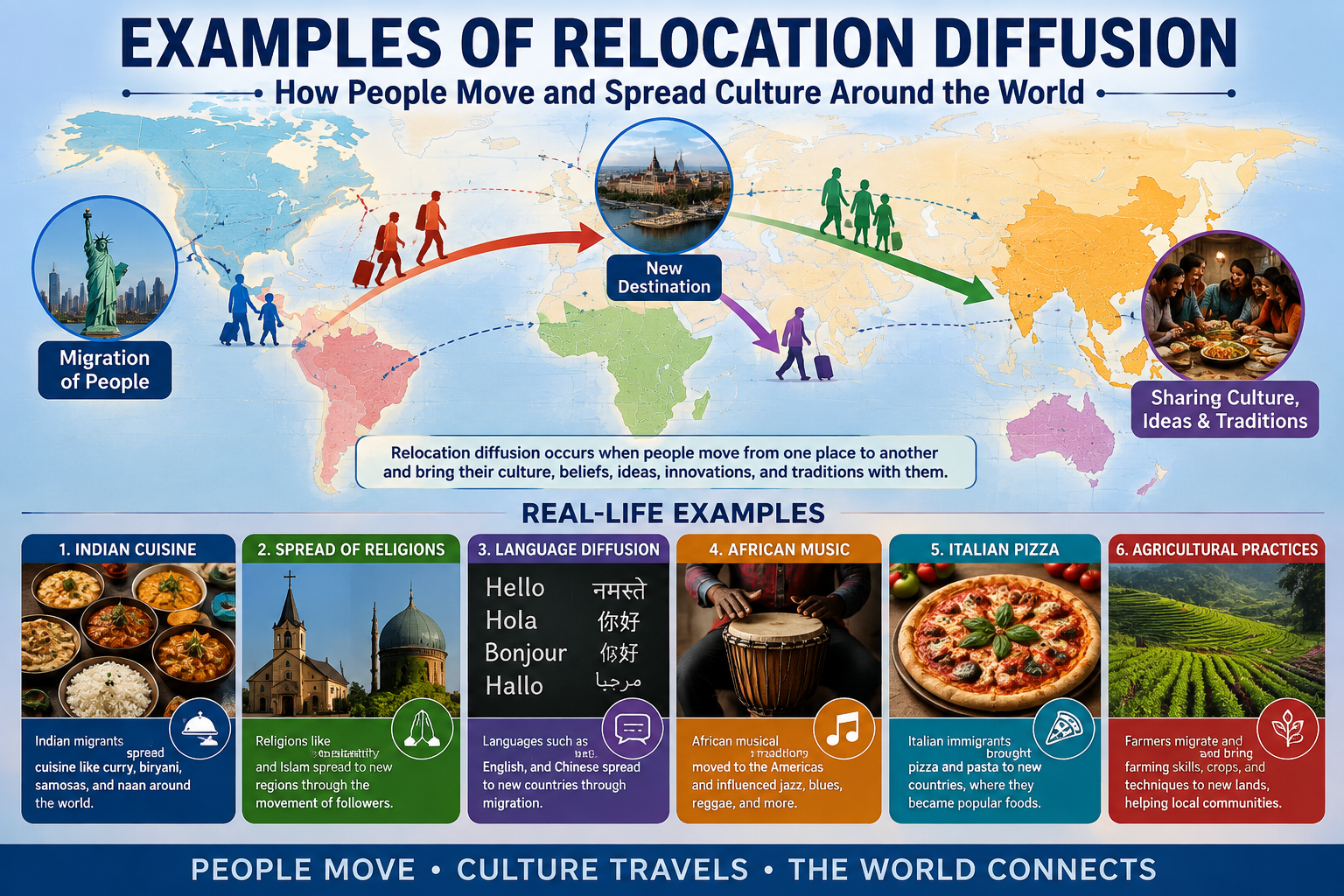
What Is Relocation Diffusion?
Relocation diffusion is a type of spatial diffusion in human geography that occurs when people physically move from one location to another and bring their ideas, cultures, traditions, languages, religions, foods, or technologies with them.
In simple terms, relocation diffusion happens when something spreads because people move.
For example, when immigrants move to a new country, they may introduce their traditional food, language, music, religious practices, or festivals to their new community. Over time, these cultural characteristics can become part of the local landscape.
Unlike some other forms of diffusion, relocation diffusion depends on physical movement. The people carrying the cultural trait move, and the trait travels with them.
Quick Answer
Examples of relocation diffusion include the spread of religions through migration, Indian cuisine becoming popular around the world, languages spreading through migration, African musical traditions influencing other regions, and technologies or agricultural practices being introduced by migrants.
How Does Relocation Diffusion Work?
Relocation diffusion generally follows a straightforward process:
- A cultural idea, practice, or innovation exists in one place.
- People who know or practice it move to another location.
- They introduce that cultural characteristic to their new community.
- Other people may adopt, adapt, or combine it with existing local practices.
- The characteristic becomes established in the new location.
The process can happen through voluntary migration, such as moving for employment or education, or through forced migration caused by conflict, persecution, slavery, or displacement.
10 Examples of Relocation Diffusion
1. Indian Food Spreading Around the World
One of the clearest examples of relocation diffusion is the international spread of Indian cuisine.
Indian migrants have established communities in Europe, North America, Africa, the Middle East, and other regions. Restaurants, grocery stores, and home cooking have helped introduce dishes such as curry, biryani, samosas, naan, and various regional foods to new populations.
This is relocation diffusion because people carried their culinary traditions with them when they moved.
2. Christianity Spreading Through Migration
Religion provides another important example.
Christian communities have historically moved across regions through migration, settlement, exploration, and missionary activity. As communities relocated, they established churches and religious institutions in new areas.
The movement of religious followers helped Christianity become established in regions far from its original centers.
3. Islam and Migration
Islam has also spread through several processes, including migration.
Muslim communities moving to different regions have established mosques, schools, businesses, and cultural institutions. These communities maintain religious practices while sometimes adapting them to their new environments.
Migration therefore plays an important role in the geographic distribution of Islam.
4. Spanish Language in the Americas
The geographic distribution of Spanish provides another useful example.
Spanish was introduced to large parts of the Americas through European colonization and settlement. Over centuries, Spanish-speaking populations grew and established communities across Central America, South America, the Caribbean, and parts of North America.
Today, Spanish is one of the world’s major languages, demonstrating how movement of people can dramatically influence linguistic landscapes.
5. African Music and Cultural Traditions
The forced migration of Africans during the transatlantic slave trade had devastating human consequences, but it also resulted in the movement of cultural traditions.
African musical rhythms, instruments, dance traditions, and cultural practices influenced developing musical forms in the Americas.
Genres and traditions that later developed in places such as the Caribbean and the United States were shaped partly by African cultural influences carried through migration.
This is an important example of how relocation diffusion can occur even under conditions of forced movement.
6. Chinese Communities and Cuisine
Chinese migration has contributed significantly to the global spread of Chinese cultural practices and cuisine.
Chinese immigrant communities established neighborhoods and businesses in many countries. Restaurants serving regional Chinese foods introduced new flavors and cooking methods to local populations.
Chinatowns in cities around the world are visible examples of cultural traits being maintained and transmitted through relocated communities.
7. Yoga and Indian Cultural Practices
Yoga provides an example of how a cultural practice can move from its original geographic context into other parts of the world.
Indian teachers, students, and communities helped introduce yoga to international audiences. As practitioners and teachers moved between countries, yoga became increasingly established outside India.
Modern yoga has also changed in different places, showing how relocation diffusion can interact with other forms of cultural diffusion.
8. Pizza and Italian Migration
Italian migration helped spread Italian food traditions internationally.
As Italian immigrants settled in countries such as the United States, they brought recipes, cooking techniques, and food traditions with them. Pizza subsequently developed into a major international food, with local variations appearing in different countries.
The original movement of people carrying Italian culinary traditions is an example of relocation diffusion.
9. Languages Spread by Migrant Communities
Migration can introduce minority languages into new areas.
For example, when communities move internationally, they may continue speaking their native languages at home, within businesses, religious institutions, schools, and community organizations.
Over generations, these languages can become important parts of multicultural urban areas.
10. Agricultural Practices Moving With People
Relocation diffusion is not limited to culture.
Farmers migrating to new areas can bring knowledge about crops, irrigation, animal husbandry, food preservation, and farming techniques. These practices may then be adopted or adapted by people living in the destination region.
This demonstrates that relocation diffusion can involve knowledge and technology as well as cultural traditions.
Relocation Diffusion vs. Expansion Diffusion
A common geography question is the difference between relocation diffusion and expansion diffusion.
| Feature | Relocation Diffusion | Expansion Diffusion |
|---|---|---|
| Physical movement | Required | Not necessarily required |
| Main mechanism | People move | Ideas spread outward |
| Example | Migrants introduce cuisine | A trend spreads through social media |
| Geographic pattern | Often follows migration routes | Spreads from existing source areas |
| Cultural transmission | Carried by people | Passed between people or places |
The key distinction is simple: relocation diffusion involves the movement of people, while expansion diffusion involves the spread of an idea without requiring the original people to move.
Why Is Relocation Diffusion Important?
Relocation diffusion helps explain why cities and countries become culturally diverse.
Migration can introduce:
- New languages
- Religious beliefs
- Foods and recipes
- Music and art
- Clothing traditions
- Agricultural knowledge
- Technologies
- Business practices
- Festivals and celebrations
- Social customs
Large cities are particularly useful places to study relocation diffusion because migration brings together people from many different geographic backgrounds.
Relocation Diffusion in Everyday Life
You may encounter relocation diffusion without realizing it.
A neighborhood restaurant serving food from another country, a cultural festival organized by an immigrant community, or a grocery store selling imported traditional products can all reflect the movement of culture through migration.
Modern transportation has also made physical relocation easier and faster. People can move between continents in hours, allowing cultural practices to become established in new places relatively quickly.
However, relocation diffusion does not mean that a cultural practice always remains unchanged. Communities frequently adapt traditions to their new surroundings.
For example, a traditional food may use locally available ingredients, while a religious or cultural celebration may develop new forms in a different country.
Relocation Diffusion and Cultural Blending
Relocation diffusion can contribute to cultural blending.
When migrants interact with the local population, their traditions may combine with existing customs. This can create new foods, music styles, languages, businesses, and cultural practices.
This process can be especially visible in multicultural cities.
For example, a restaurant may combine traditional cooking techniques from one country with ingredients or preferences common in another. Over time, these adaptations can become distinctive local traditions.
Frequently Asked Questions
What is an example of relocation diffusion?
A simple example is immigrants moving to another country and introducing their traditional cuisine. Indian, Italian, Chinese, and Mexican foods have spread internationally partly through migration.
What are three examples of relocation diffusion?
Three examples include the spread of Indian cuisine through migration, the introduction of languages into new countries by immigrant communities, and the movement of religious practices with migrating populations.
Is migration an example of relocation diffusion?
Migration itself is the mechanism that allows relocation diffusion to occur. When migrants carry cultural ideas, traditions, languages, or practices to their destination, those characteristics can spread through relocation diffusion.
What is the difference between relocation and expansion diffusion?
Relocation diffusion occurs when people physically move and carry a cultural characteristic with them. Expansion diffusion occurs when an idea spreads from person to person or place to place without requiring the original source population to relocate.
Can technology spread through relocation diffusion?
Yes. People can carry technological knowledge, skills, and practices when they move to another location. Migrants may introduce new production methods, farming techniques, business practices, or other forms of knowledge.
For additional geographic and migration research, use authoritative sources such as the U.S. Census Bureau
Conclusion
The examples of relocation diffusion found around the world demonstrate how human movement shapes geography and culture. Migration can carry food, language, religion, music, technology, agricultural knowledge, and traditions from one region to another.
From Indian cuisine and Italian pizza to languages, religious practices, and musical traditions, relocation diffusion helps explain why cultural characteristics appear far beyond their original geographic locations.
Understanding relocation diffusion is therefore essential for studying migration, globalization, cultural landscapes, and human geography.
1 thought on “Examples of Relocation Diffusion: 10 Real Cases”