What Is Recyclatanteil?
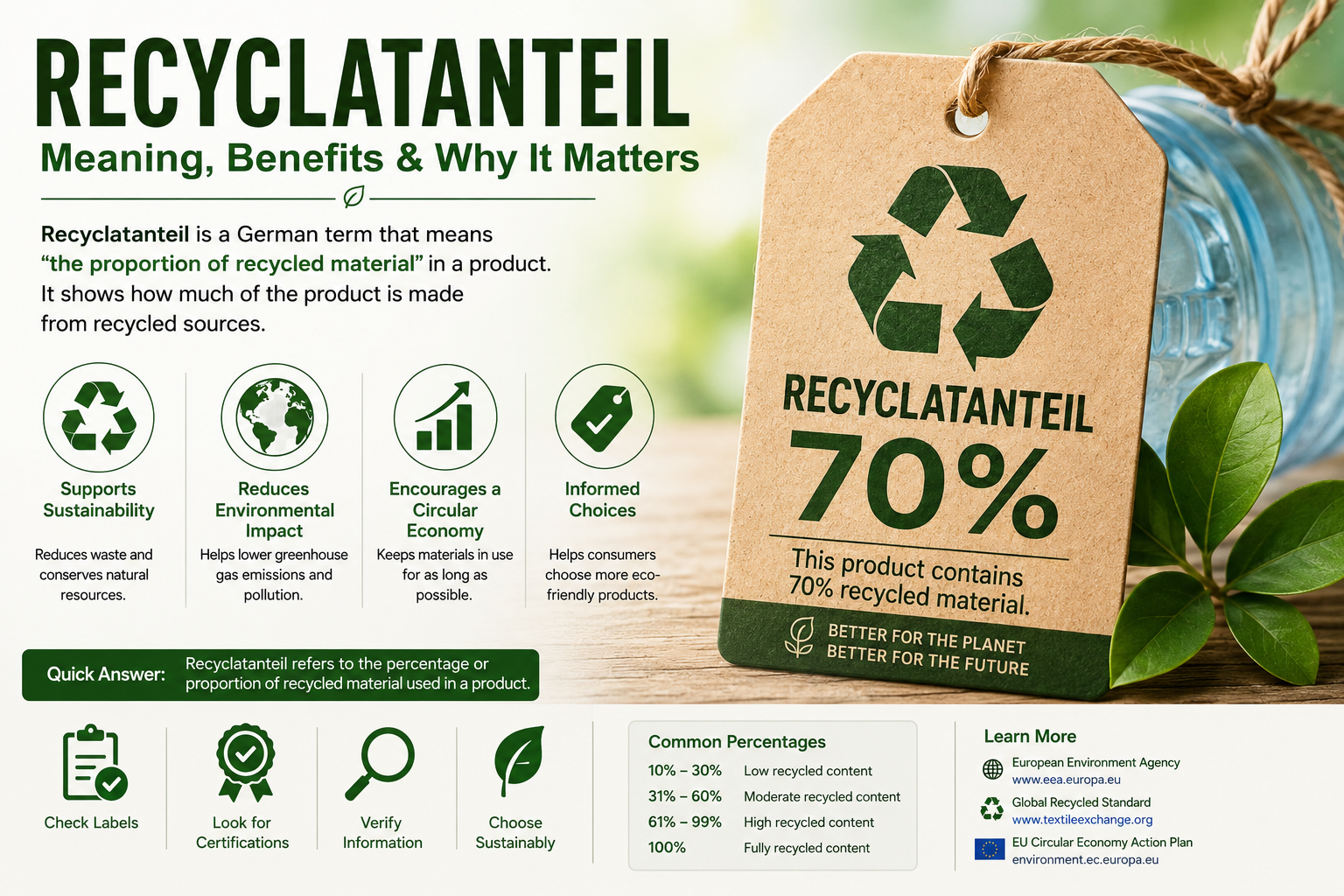
Recyclatanteil is a German term that means “recycled content share” or “proportion of recycled material.” It describes how much of a product or material consists of recycled raw material.
The word is made up of two German terms:
- Recyclat = recycled material
- Anteil = share, proportion, or percentage
For example, if a product is labelled “Recyclatanteil 50%,” it generally indicates that 50% of the relevant material content comes from recycled sources.
The term is particularly relevant to plastic products, packaging, textiles, construction materials, furniture, and other sustainable products.
For consumers, understanding Recyclatanteil can make it easier to compare products and identify claims related to recycled content.
Quick answer: Recyclatanteil refers to the percentage or proportion of recycled material contained in a product or material.
Why Does Recyclatanteil Matter?
Recycling is an important part of the transition toward a more circular economy. Instead of constantly using virgin raw materials, manufacturers can incorporate recovered materials into new products.
A higher recycled content percentage can potentially provide several environmental benefits, depending on the material and recycling process.
1. Reduces Dependence on Virgin Materials
Using recycled materials can reduce the demand for newly extracted or produced raw materials. This is particularly important for industries that rely heavily on resources such as petroleum, metals, timber, or minerals.
2. Helps Reduce Waste
When waste materials are collected and processed into usable raw materials, they can be kept within the production cycle rather than being sent directly to landfill or incineration.
3. Supports a Circular Economy
A circular economy aims to keep products and materials in use for as long as possible. Recyclatanteil is relevant because it shows how much recycled material has been incorporated into a new product.
For more information about circular economy principles, you can also explore our sustainability and environmental guides.
4. Can Reduce Environmental Impact
The environmental benefit of recycled content depends on many factors, including collection systems, transportation, processing energy, material type, and manufacturing methods. Therefore, a higher percentage does not automatically mean that every product has a lower overall environmental footprint.
The European Environment Agency provides further information about Europe’s transition toward a circular economy.
Common Recyclatanteil Percentages
Recyclatanteil can vary considerably between products. There is no single percentage that applies to every type of product.
| Recyclatanteil | General Meaning | Possible Use |
|---|---|---|
| 10%–30% | Lower recycled content | Packaging and everyday products |
| 31%–60% | Moderate recycled content | Bottles, containers and household products |
| 61%–99% | High recycled content | Textiles, furniture and eco-products |
| 100% | Entire relevant material is recycled content | Certain specialised products |
These ranges are provided as a simple educational comparison. Actual labelling requirements and calculation methods can differ depending on the product, material, market, and certification system.
How Is Recyclatanteil Calculated?
The basic concept is relatively straightforward.
A manufacturer can determine the proportion of recycled material by comparing the quantity of recycled material with the total relevant material used.
A simplified formula is:
Recyclatanteil (%) = Recycled Material ÷ Total Material × 100
For example, suppose a product contains:
- 40 kg recycled material
- 60 kg virgin material
- 100 kg total material
The calculation would be:
40 ÷ 100 × 100 = 40%
Therefore, the product would have a 40% recycled content share under this simplified calculation.
However, real-world certification and regulatory calculations can be more complicated. Manufacturers may need to follow specific definitions, documentation requirements, mass-balance methods, production controls, or chain-of-custody rules.
Recyclatanteil vs. Recyclable: What Is the Difference?
These two terms are often confused, but they describe different things.
Recyclatanteil refers to the recycled content already present in a product.
Recyclable generally refers to whether a product or material can potentially be collected and processed for recycling under an appropriate recycling system.
For example, a plastic container could be recyclable but contain no recycled material.
Likewise, another product could contain recycled material but have limited recyclability after its useful life because of its composition or local recycling infrastructure.
Understanding this difference is important when evaluating sustainability claims.
Standards and Certifications for Recycled Content
Because recycled-content claims can influence purchasing decisions, independent standards and certifications can provide additional transparency.
Global Recycled Standard (GRS)
The Global Recycled Standard (GRS) is a widely recognised standard used to verify recycled materials and encourage responsible production practices.
You can learn more through the official Global Recycled Standard information from Textile Exchange.
ISO 14021
ISO 14021 covers environmental labels and declarations, including requirements relevant to self-declared environmental claims.
It is particularly useful when companies make environmental statements about their products and materials.
EU Environmental Policies
European environmental policy increasingly focuses on resource efficiency, waste reduction, sustainable products, and circular economy principles.
The European Union’s Circular Economy Action Plan provides useful background on these efforts.
How to Check Recyclatanteil on a Product
If you want to find out how much recycled material a product contains, follow these steps.
Step 1: Check the Product Label
Look for terms such as:
- Recycled content
- Recycled material
- Recyclatanteil
- Post-consumer recycled (PCR)
- Post-industrial recycled (PIR)
Step 2: Read the Manufacturer’s Information
Some companies provide detailed information on their websites or product documentation. Check whether the percentage refers to the entire product or only a particular component.
Step 3: Look for Certification
A recognised certification can provide additional confidence that recycled-content claims have been assessed according to a defined standard.
Step 4: Check the Calculation Method
A percentage alone does not always tell the complete story. If sustainability is important to you, check what material is included in the calculation and whether the claim applies to the complete product.
Post-Consumer and Post-Industrial Recycled Material
Not all recycled materials come from the same source.
Post-Consumer Recycled Material
Post-consumer recycled (PCR) material comes from products or packaging that have already been used by consumers and collected for recycling.
Examples can include used plastic bottles, packaging, and other consumer products.
Post-Industrial Recycled Material
Post-industrial recycled (PIR) material generally comes from manufacturing processes. It can include production scraps or materials that are recovered and reused before reaching consumers.
Both can contribute to resource efficiency, but they represent different sources of recycled material.
Is a Higher Recyclatanteil Always Better?
Not necessarily.
A higher recycled content percentage can be beneficial, but it should not be considered the only measure of a product’s sustainability.
Other factors can include:
- Product durability
- Energy used during manufacturing
- Transportation
- Chemical use
- Product recyclability
- Packaging
- Expected lifespan
- End-of-life options
For example, a durable product that lasts many years may have advantages over a short-lived alternative, even if the latter contains a higher percentage of recycled material.
The best approach is to consider the whole product life cycle rather than focusing on one number.
The Future of Recyclatanteil
The importance of recycled content is likely to continue growing as governments, manufacturers, and consumers place greater emphasis on resource efficiency.
Improved recycling technology could make it easier to recover materials from increasingly complex products. At the same time, better labelling and certification systems can help consumers understand environmental claims.
Businesses are also under increasing pressure to demonstrate where their materials come from and how products fit into broader circular-economy strategies.
As these developments continue, Recyclatanteil may become an increasingly familiar term on packaging and product labels.
Frequently Asked Questions About Recyclatanteil
What does Recyclatanteil mean?
Recyclatanteil is a German term meaning the proportion or percentage of recycled material contained in a product or material.
Is Recyclatanteil the same as recycled content?
Yes. In most product-labelling contexts, Recyclatanteil refers to the share of a product’s material that comes from recycled sources.
How is Recyclatanteil calculated?
A simplified calculation divides the amount of recycled material by the total relevant material and multiplies the result by 100.
Is 100% Recyclatanteil possible?
Yes, some products or materials can contain 100% recycled content. However, the exact claim depends on what part of the product is being measured and the applicable standards or certification rules.
Does higher recycled content always mean a better product?
No. Recycled content is only one sustainability factor. Durability, manufacturing impacts, recyclability, transportation, and end-of-life management should also be considered.
Conclusion
Recyclatanteil is an important term for understanding recycled content in modern products. It tells consumers and businesses how much of the relevant material comes from recycled sources and can provide useful information when comparing products.
However, recycled content should be viewed as part of a broader sustainability picture. Checking certifications, understanding product labels, and considering durability and end-of-life options can help you make more informed decisions.
As the circular economy develops, understanding terms such as Recyclatanteil, recycled content, PCR, and recyclable will become increasingly useful for both consumers and businesses.