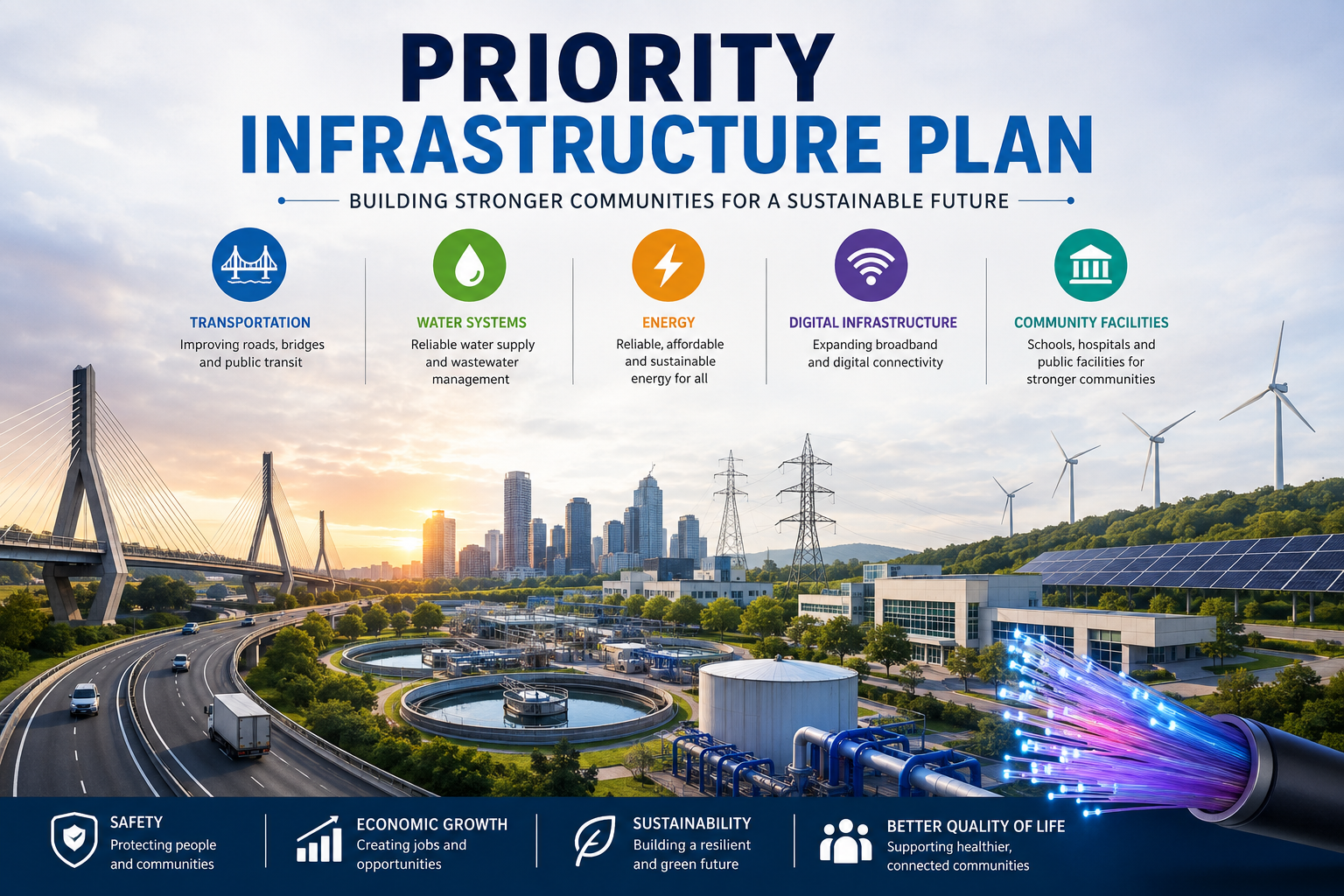
What Is a Priority Infrastructure Plan?
A priority infrastructure plan is a structured strategy for identifying, funding, and delivering the infrastructure projects that are considered most important to a community, region, organization, or country. It helps decision-makers focus limited resources on projects that can provide the greatest economic, social, environmental, and public-service benefits.
Instead of treating every infrastructure project as equally urgent, a priority plan ranks projects according to factors such as safety, economic impact, population needs, cost, resilience, and long-term value.
In simple terms, a priority infrastructure plan answers three important questions:
- What infrastructure needs attention first?
- Why should those projects receive priority?
- How will they be funded, delivered, and monitored?
Why Is a Priority Infrastructure Plan Important?
Infrastructure affects almost every part of modern life. Roads connect businesses and communities, water systems support public health, energy networks power homes and industries, and digital infrastructure enables communication and economic activity.
A well-designed priority infrastructure plan helps organizations make informed decisions instead of allocating money based only on political pressure, short-term demands, or isolated problems.
The approach can also improve transparency. When project priorities are based on clearly defined criteria, residents, businesses, investors, and other stakeholders can better understand why certain projects are being developed before others.
How Does a Priority Infrastructure Plan Work?
A priority infrastructure plan normally begins with an assessment of existing infrastructure and future needs. Decision-makers then identify potential projects and compare them using consistent criteria.
A typical process includes:
- Assess existing infrastructure
Identify aging, damaged, overloaded, unsafe, or inadequate infrastructure. - Identify future needs
Consider population growth, economic development, climate risks, technology, and changing demand. - Create a project pipeline
Develop a list of possible infrastructure projects. - Evaluate each project
Compare cost, benefits, urgency, risk, feasibility, and expected outcomes. - Rank projects
Assign priorities using an agreed assessment framework. - Develop funding strategies
Identify public funding, private investment, grants, loans, or other financing options. - Create an implementation schedule
Establish realistic timelines, responsibilities, milestones, and performance indicators.
Key Elements of a Strong Infrastructure Priority Plan
A successful plan needs more than a list of projects. It should explain why each project matters and how it supports wider strategic goals.
1. Clear Strategic Objectives
The plan should begin with measurable objectives. These might include improving transportation, increasing energy reliability, expanding broadband access, reducing flood risk, or supporting economic growth.
Clear objectives make it easier to determine whether a proposed project genuinely deserves priority.
2. Infrastructure Condition Assessment
Understanding the condition of existing assets is essential. Aging bridges, water pipes, electrical networks, public buildings, and transportation systems may require investment before new projects are considered.
Condition assessments can help identify safety risks and prevent unexpected failures.
3. Cost and Benefit Analysis
Projects should be assessed against their expected costs and benefits.
| Factor | Key Question | Why It Matters |
|---|---|---|
| Cost | How much will the project require? | Determines affordability |
| Safety | Does it reduce a significant risk? | Protects people and assets |
| Economic impact | Will it support jobs or investment? | Strengthens the economy |
| Public benefit | How many people will benefit? | Measures community value |
| Resilience | Can it withstand future risks? | Supports long-term reliability |
| Urgency | What happens if it is delayed? | Helps establish priority |
Cost alone should not determine which project comes first. A relatively expensive project may be more important if delaying it creates major safety, economic, or environmental risks.
Common Types of Priority Infrastructure
A priority infrastructure plan can cover many different sectors.
Transportation Infrastructure
Transportation projects can include highways, bridges, public transportation, rail systems, airports, ports, cycling infrastructure, and pedestrian improvements.
Priority may be given to projects that reduce congestion, improve safety, strengthen freight movement, or connect underserved communities.
Water and Wastewater Infrastructure
Water infrastructure includes drinking-water systems, treatment plants, pipelines, reservoirs, stormwater networks, and wastewater facilities.
Investment in these systems can be particularly important where assets are aging or where population growth is increasing demand.
Energy Infrastructure
Energy priorities may include electricity transmission and distribution, generation facilities, energy storage, and grid modernization.
Reliable energy infrastructure is increasingly important for households, businesses, hospitals, transportation systems, and digital services.
Digital Infrastructure
Modern infrastructure planning increasingly includes broadband networks, data connectivity, telecommunications, and other digital systems.
Reliable digital infrastructure can support education, healthcare, remote work, public services, and business development.
Public and Community Infrastructure
Schools, hospitals, emergency facilities, government buildings, housing-related infrastructure, and community facilities can also form part of a priority infrastructure plan.
How Are Infrastructure Projects Prioritized?
There is no universal formula that works for every region. However, decision-makers commonly consider several broad factors.
Public Safety
Projects addressing immediate safety risks often receive high priority. Examples may include repairing structurally deficient infrastructure or upgrading systems that pose significant public-health risks.
Economic Development
Infrastructure can create conditions for businesses to expand, workers to reach employment, and goods to move efficiently.
Projects that remove major economic bottlenecks may therefore receive higher priority.
Population and Community Need
A project serving a large population may have significant benefits, but planners should also consider underserved communities where relatively small investments could address serious infrastructure gaps.
Environmental Considerations
Infrastructure decisions can affect land, water, air quality, ecosystems, and natural resources. Environmental impacts should be considered throughout project planning and delivery.
Resilience
Infrastructure needs to perform under changing conditions. Flooding, extreme weather, supply disruptions, cyber risks, and other hazards can influence which projects should receive priority.
Benefits of a Priority Infrastructure Plan
A strong plan can provide several advantages.
- Better allocation of limited funding
- Greater transparency in decision-making
- Improved infrastructure reliability
- Better long-term financial planning
- Reduced exposure to infrastructure failures
- Stronger economic development
- Improved public services
- Greater coordination between agencies
- More effective project scheduling
Perhaps the biggest benefit is that infrastructure investment becomes more strategic. Instead of reacting to problems one at a time, organizations can establish a long-term framework for managing their infrastructure needs.
Challenges in Developing an Infrastructure Priority Plan
Creating a priority infrastructure plan is not always straightforward.
Limited Funding
Infrastructure requirements can be much larger than available budgets. Decision-makers may have to postpone worthwhile projects because funding is limited.
Changing Priorities
Economic conditions, population changes, emergencies, technological developments, and government policies can change infrastructure needs.
A good plan should therefore be reviewed and updated rather than treated as permanently fixed.
Cost Uncertainty
Large infrastructure projects can experience changes in construction costs, material prices, labor costs, and financing conditions.
Contingency planning and realistic estimates are important for reducing financial surprises.
Stakeholder Conflicts
Residents, businesses, government agencies, investors, and community organizations may have different views about which projects deserve priority.
Public engagement and transparent evaluation criteria can help manage these differences.
How Technology Can Improve Infrastructure Planning
Digital tools can make infrastructure planning more efficient.
Geographic information systems can help planners visualize infrastructure assets and identify geographic gaps. Asset-management systems can track the condition and maintenance history of infrastructure.
Data analysis can also help decision-makers compare projects using measurable indicators.
For example, planners might combine information about population, infrastructure condition, traffic volumes, flood exposure, maintenance costs, and economic activity to identify areas where investment could have the greatest impact.
Technology does not replace professional judgment, but it can provide better evidence for decision-making.
Priority Infrastructure Plan vs. Traditional Project Planning
A traditional approach may focus heavily on individual projects. A priority infrastructure plan takes a broader view.
| Priority Infrastructure Plan | Traditional Project Approach |
|---|---|
| Looks across multiple projects | Often focuses on one project |
| Uses defined priorities | Priorities may vary between projects |
| Supports long-term planning | May focus on immediate delivery |
| Considers competing needs | May evaluate projects separately |
| Links investment to strategic goals | Can focus mainly on project completion |
The two approaches are not necessarily opposites. Individual projects still need detailed planning, but a priority infrastructure plan helps determine which projects should receive attention first and why.
How to Build an Effective Priority Infrastructure Plan
Organizations developing a plan can follow a practical framework.
Step 1: Establish the Planning Scope
Define the geographic area, infrastructure sectors, planning period, and organizations involved.
Step 2: Gather Reliable Data
Collect information about asset condition, capacity, demand, maintenance requirements, costs, risks, and community needs.
Step 3: Identify Infrastructure Gaps
Determine where current infrastructure is failing to meet present or future requirements.
Step 4: Develop Project Options
Create potential solutions rather than automatically selecting a single project.
Step 5: Establish Evaluation Criteria
Use transparent criteria such as safety, urgency, cost, benefits, resilience, environmental impact, and community need.
Step 6: Rank Projects
Score or otherwise compare projects using the agreed framework.
Step 7: Match Projects With Funding
Identify realistic funding sources and consider the financial requirements across the entire project lifecycle.
Step 8: Create a Delivery Roadmap
Set priorities for immediate, medium-term, and longer-term investment.
Step 9: Monitor Results
Track whether projects are being delivered on time, within budget, and against their intended outcomes.
What Makes an Infrastructure Priority Plan Successful?
A successful priority infrastructure plan is evidence-based, transparent, financially realistic, and flexible enough to respond to changing conditions. It should connect infrastructure investment to measurable public or organizational outcomes rather than simply listing construction projects. Regular reviews help keep priorities aligned with emerging needs and available resources.
The Future of Infrastructure Prioritization
Infrastructure planning is becoming increasingly focused on resilience, sustainability, technology, and long-term value.
Future plans are likely to consider not only whether infrastructure can meet today’s demand but also whether it can remain reliable as circumstances change.
Population growth, urbanization, digital transformation, climate-related risks, energy transitions, and changing transportation patterns can all influence infrastructure priorities.
This makes long-term planning particularly important. Infrastructure assets can remain in service for decades, so decisions made today can affect communities and organizations for generations.
Frequently Asked Questions
What is a priority infrastructure plan?
A priority infrastructure plan is a strategic framework used to identify and rank infrastructure projects according to factors such as safety, urgency, cost, public benefit, economic impact, and resilience.
Why do governments need infrastructure priority plans?
Governments often face more infrastructure needs than available funding. A priority plan provides a structured way to decide which projects should receive investment first.
What infrastructure projects are usually considered high priority?
High-priority projects may include those addressing serious safety risks, critical service failures, major capacity constraints, essential public services, or significant economic and community needs.
Can infrastructure priorities change?
Yes. Priorities can change because of emergencies, population growth, economic conditions, new risks, funding changes, or changes in government and community objectives.
How often should an infrastructure plan be reviewed?
There is no single review schedule suitable for every organization. However, plans should be monitored regularly and formally reassessed when significant changes affect infrastructure needs, funding, risks, or strategic objectives.
Conclusion
A priority infrastructure plan provides a practical framework for making better infrastructure investment decisions. By assessing existing assets, identifying future needs, evaluating risks, comparing project benefits, and connecting priorities with available funding, organizations can move from reactive maintenance toward strategic infrastructure management.
The strongest plans are not simply lists of construction projects. They explain why investment is needed, who benefits, what risks are addressed, how projects will be funded, and how success will be measured.
As infrastructure challenges become more complex, transparent and evidence-based prioritization will remain an important part of responsible long-term planning.
For broader general news and current affairs coverage, visit HEADLINE.CO.UK